
Paper Review
Pre-submission manuscript review by four AI reviewers
Four AI reviewers read your manuscript the way a journal panel would. They quote the passages they question, so you can fix what a reviewer would flag before you submit. A standard review is usually ready in 4 to 8 minutes. Deep Review takes 10 to 15. Three tiers, $9 to $15, one-time payment, no subscription.
Who runs this. Built by Benjamin Ampel, assistant professor of computer information systems at Georgia State University, with publications in MIS Quarterly and JMIS.
Tested on retracted papers. In my own test on 23 open-access papers later retracted for a documented error, the review pointed at that problem in 14, partly in 4, and missed 5. Run against reports written for unrelated papers, the same judge said yes in 2 of 46 cases. One model judged, and the counts may move on a rerun. Read the method and the limits.
Allowed under the author policies of Elsevier, Springer Nature, Wiley, IEEE, ACM and NeurIPS (see the policy question below). The manuscript goes to Anthropic's API, which keeps it up to 30 days and does not train on it. Purplelink deletes it 30 minutes after you first open the result.
Field profiles for machine learning, biomedicine, psychology and social science, chemistry, or a general one for everything else. Economics, sociology and political science papers use the social science profile.
A colleague shared this link. Pay with a .edu email address and you each receive a $2 code toward a later review.
- Pay through Stripe
- Upload your manuscript as a PDF or Word (.docx) file, up to 20 MB. The link is also emailed, so you can upload from another device
- Read the report, usually in 4 to 8 minutes
Report by email, manuscript deleted. The report is emailed to you as a PDF. Purplelink deletes the manuscript and the online copy 30 minutes after you first open the result, or after 24 hours if you never do. Anthropic keeps API inputs for up to 30 days and does not train on them. If a result reads as low quality, email within 14 days for a refund. Advisory only: you decide what to change.
Check your references first, free
Upload the PDF or Word file to see how many of its references CrossRef can confirm and whether any cited paper has been retracted. The check quotes up to three findings from your manuscript. No payment, no account.
Watch the tour
What a Paper Review looks like
Four reviewers, every reference checked against CrossRef, and a fix checklist.
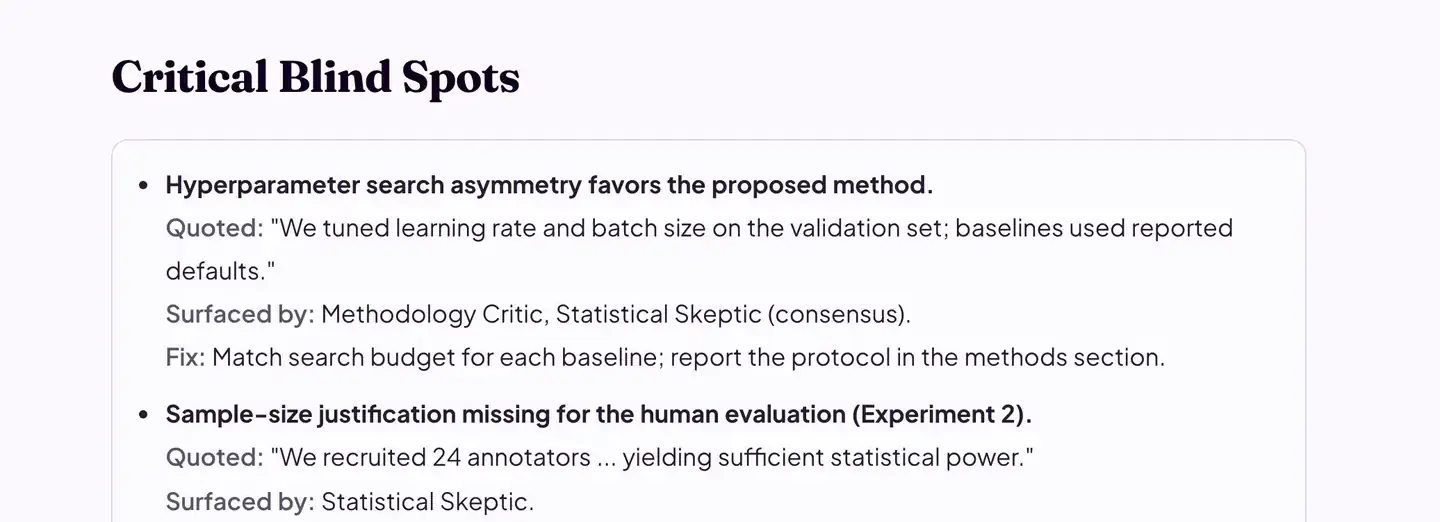
An excerpt from a real report on a machine-learning paper
Every finding quotes the passage it is about.
Critical blind spots
Hyperparameter search asymmetry favors the proposed method.
Quoted: "We tuned learning rate and batch size on the validation set; baselines used reported defaults."
Surfaced by: Methodology Critic, Statistical Skeptic (consensus).
Fix: Match the search budget for each baseline and report the protocol in the methods section.
Data-to-claim contradictions
- Claim: "Our method beats all baselines by a wide margin."
Evidence: Table 2 shows the proposed method tied with Baseline C within reported standard errors on 4 of 7 datasets.
Rectification checklist
- A Add the hyperparameter search protocol to the methods (page 5, Section 3.2).
- B Reference [17] only weakly matches its CrossRef entry. Check the title and DOI.
- C Figure 3's y-axis breaks 0-60 then jumps to 90; redraw on a continuous scale.
References and citation support
47 of 52 references verified against CrossRef; 3 weak title matches to re-check.
Claim "Method X reduces error by 40%" cites [14], whose abstract reports a 4% reduction. Verdict: contradicted.
A human pre-submission edit usually costs several hundred dollars and takes a week. This takes 4 to 15 minutes.
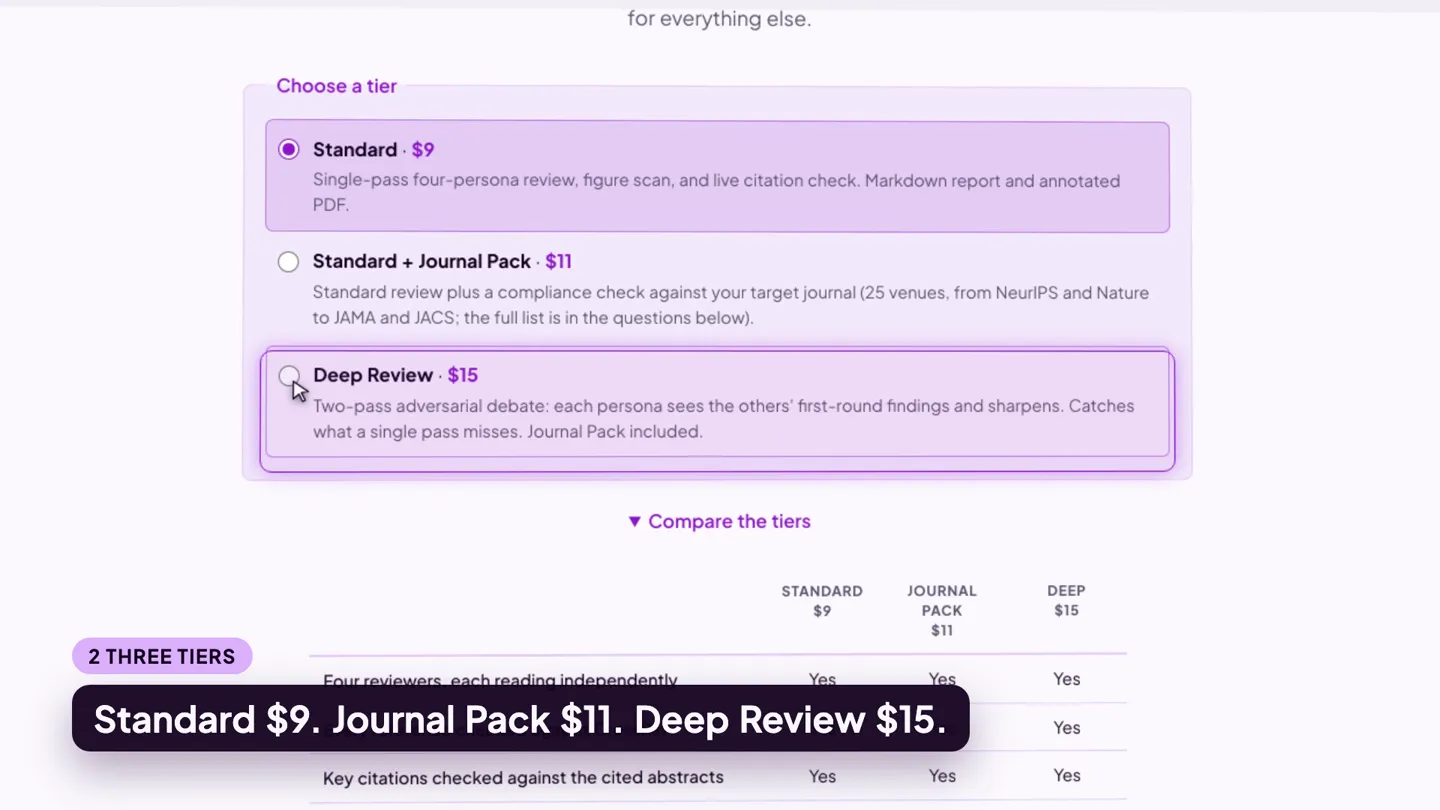
Compare the tiers
| Feature | Standard $9 | Journal Pack $11 | Deep $15 |
|---|---|---|---|
| Four reviewers, each reading independently | Yes | Yes | Yes |
| Every reference checked against CrossRef | Yes | Yes | Yes |
| Key citations checked against the cited abstracts | Yes | Yes | Yes |
| Figure and table scan | Yes | Yes | Yes |
| Anonymity scan for double-blind review | Yes | Yes | Yes |
| Check against one of 25 venues' submission rules | No | Yes | Yes |
| A second round: each reviewer sees the others' findings and revises its own | No | No | Yes |
| Usual time | 4 to 8 min | 4 to 8 min | 10 to 15 min |
Reviewing more than one manuscript? Volume packs save 16-17% per review. Buying for a lab? See invoices, purchase orders and data handling.
How the review works
- Methodology CriticDesign, controls, confounds and what the method can and cannot show.
- Statistical SkepticPower, tests, intervals and claims the numbers do not support.
- Data Integrity OfficerFigures, tables and whether the data shown matches the text.
- Editor-in-ChiefNovelty, fit, structure and what a desk editor would send back.
- Layer 1: figure-integrity scan. Every page is rendered and reviewed for digital manipulation concerns, figure-vs-text contradictions, and presentation issues (broken y-axes, missing error bars, color-only encoding). The language is hedged. It flags concerns to investigate and never makes accusations.
- Layer 2: citation support audit. Every reference is verified against CrossRef, then we go deeper: for the most load-bearing claims, we fetch the cited source's abstract and check whether it actually supports the claim you attached it to. Each finding shows your claim next to the source's own words, with a verdict: supported, partially supported, not supported by the abstract, contradicted, or source unavailable. The language is hedged, so verify each finding against the full text.
- Layer 3: a four-reviewer panel. Methodology Critic, Statistical Skeptic, Data Integrity Officer, and Editor-in-Chief each red-team the paper in parallel. Findings are merged with a cross-persona consensus filter so issues raised independently by multiple personas surface first.
- Layer 4: the report. A final pass produces the structured report you'll act on: critical blind spots, data-to-claim contradictions, an A/B/C rectification checklist, and an honest novelty estimate.
What you get
- One review of one manuscript (up to 20 MB, PDF or Word .docx, ~100 pages). To have supplementary material read too, merge it into the same file.
- An anonymity scan for double-blind submission on every tier: author names, institutions, funders, protocol numbers and self-citations left in the text.
- A Markdown report and an annotated PDF with comments on the pages they refer to.
- Standard reviews are usually ready in 4-8 minutes, Deep Review in 10-15, on a status page that updates itself.
Reviewing a grant proposal instead of a paper? Grant Review is an idea for NSF and NIH proposals, and the waitlist measures interest.
How your manuscript is handled
- Analysis. A Word file is first converted to PDF on our server, and the PDF is read in memory. To check figures and tables, pages are rendered to images from a private temporary file that is deleted as soon as the rendering finishes.
- Anthropic. The text and page images are sent to Anthropic's Claude API. Anthropic keeps API inputs for up to 30 days for abuse monitoring and does not train on them.
- Delivery and deletion. The report is emailed to you as a PDF when the review finishes. The manuscript and the online copy are deleted 30 minutes after you first open the result, or after 24 hours if you never open it. The email is sent through Resend and carries the report only, never the manuscript or the annotated PDF.
- What we keep. A permanent cost record per job: product, status, price, token counts and model names. It contains no manuscript text.
Frequently asked questions
What does the review include?
How long does it take?
What about my privacy? Is the manuscript stored?
Which journals does the Journal Pack check?
25 venues. The pack checks word and abstract limits, required sections and reference-style hints against the one you pick at upload.
- Machine learning: NeurIPS, ICML, ICLR, AAAI, TMLR, JMLR
- General science: Nature, Science, Cell, PLOS ONE
- Medicine: Nature Medicine, JAMA, NEJM, The Lancet, The BMJ
- Psychology and management: Psychological Science, Journal of Personality and Social Psychology, Cognition, Academy of Management Journal
- Chemistry and materials: JACS, Angewandte Chemie, Nature Materials, Nature Chemistry, ACS Nano, Advanced Materials
Not listed? The Standard tier covers everything except this check. Email to ask for a venue.