
Researchers preparing to submit use Paper Review to find the problems a real reviewer will flag: figure integrity, citation support, and methodological blind spots.
Steps
-
Compile your manuscript to PDF. Paper Review accepts PDF files up to 20 MB. If you're working in LaTeX, use the free LaTeX to PDF tool if you don't have a local install. In Word, use File > Export > PDF.
-
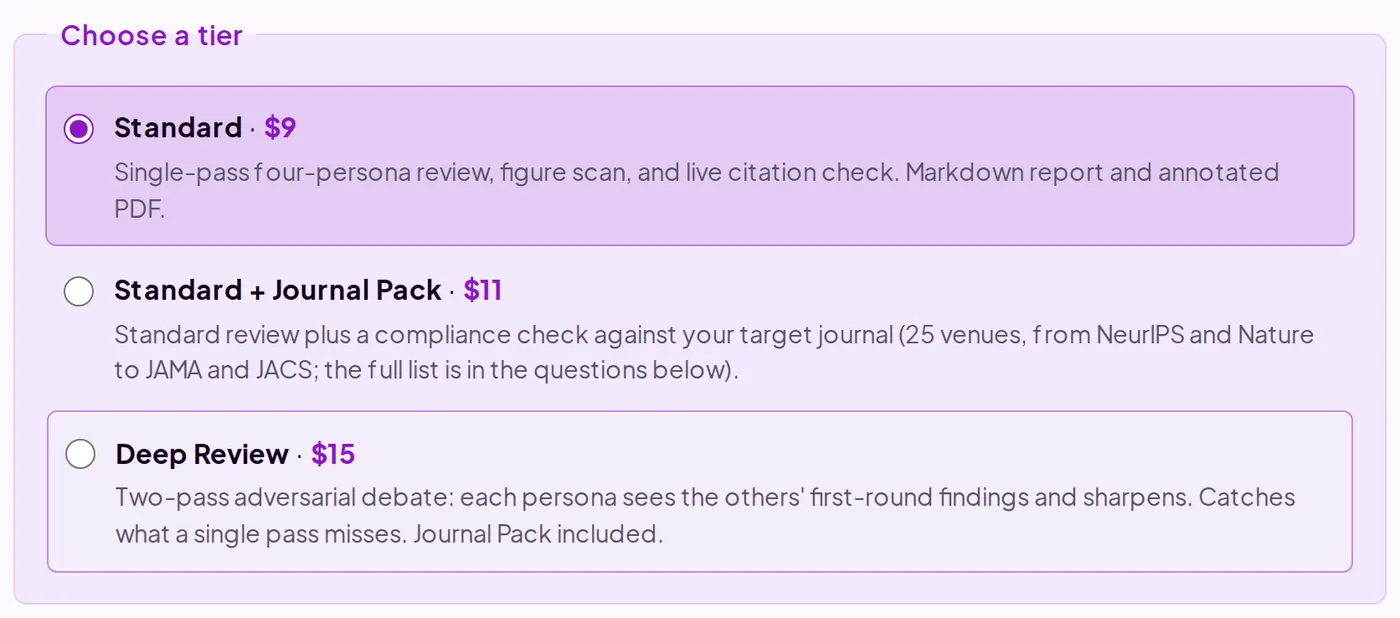
Go to purplelink.llc/tools/paper-review/ and choose a tier. Standard ($9) runs the full four-layer review. Journal Pack ($11) adds a compliance check against your target journal. Deep Review ($15) runs two adversarial passes so each persona sharpens against the others' first-round findings.
-
Click the checkout button and pay through Stripe. You're taken to the upload page (the link is also emailed to you): upload the PDF, pick the field profile that fits, and submit. A status page then updates on its own until the review is ready, usually in 4 to 8 minutes, or 10 to 15 for Deep Review.
-
When the report appears, read Critical Blind Spots first. These are the few most important issues in the review, each tagged by confidence; findings more than one reviewer raised are marked as consensus. Each finding quotes your manuscript and names the personas that raised it.
-
Work through the Rectification Checklist in A/B/C order. A-priority items need to be addressed before submission. B items strengthen the paper. C items are minor presentation fixes.

-
Check the Citation Support Audit. References marked "Contradicted" need verification against the full source text. "Not supported by abstract" means the claim may appear in the paper body but wasn't confirmed at the abstract level. "Source unavailable" means no abstract could be retrieved for that source, so the claim was not checked; check it against the paper yourself.
-
Download or copy the Markdown report before closing the tab. The review is deleted from Purplelink's servers 30 minutes after you first open it (or after 24 hours if you never do). It is not recoverable once the tab is closed.
What's happening under the hood
The review runs four layers in sequence. Layer 1 renders every page as an image and examines figures for integrity issues: broken axes, missing error bars, discrepancies between a figure and its caption. Layer 2 checks every reference against CrossRef, then fetches the abstracts of the most load-bearing cited sources and compares them to your claims. Layer 3 runs four AI personas in parallel: Methodology Critic, Statistical Skeptic, Data Integrity Officer, and Editor-in-Chief. A consensus filter surfaces findings raised by more than one persona first. Layer 4 synthesizes the structured report with blind spots, contradictions, the rectification checklist, and a novelty estimate. Your domain profile (Machine Learning, Biomedicine, Psychology, Chemistry, or General) loads the attack vectors relevant to your field.
Q&A
Does the review replace peer review?
No. Use it as a first-pass audit to fix the obvious problems before a real reviewer sees them. Every editorial decision remains yours.
What if a finding is wrong?
Each finding quotes the relevant text so you can verify it. If a whole result reads as poor quality, email ben@purplelink.llc for a refund.
My paper contains patient data. Is it safe to upload?
Redact any identifiable patient information before uploading. The manuscript is sent to Anthropic's Claude API, which retains inputs for up to 30 days for abuse monitoring.
Run a review at purplelink.llc/tools/paper-review/.