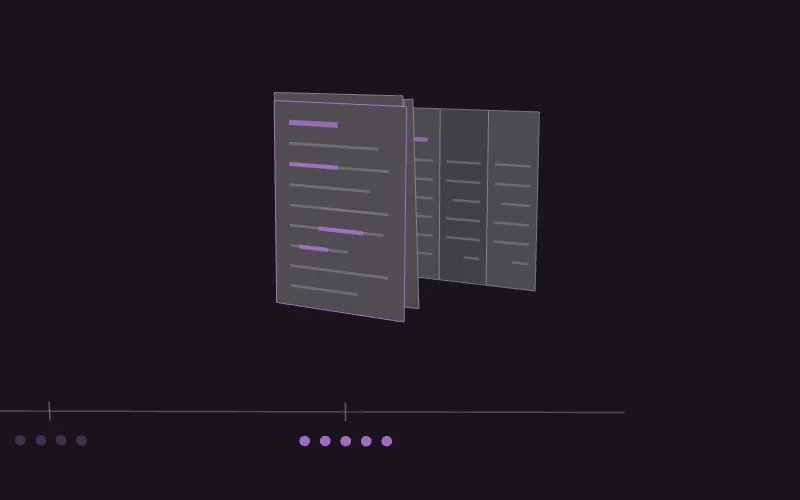
Reviews for one paper, from submission to response letter
Three AI reviews follow a manuscript through peer review. Paper Review reads it before you submit. Revision Review checks the revised version against that first report. Response Review reads your response letter against the reviewers' comments, or drafts the letter for you. Each one is paid once, and you do not need an account.
A chat assistant reads your PDF once and answers in one pass. Paper Review checks every reference against CrossRef, recomputes your statistics without a language model, reads the first 30 pages as images, and has seven separate reviewers read the paper before one pass reconciles what they found.
A chat promptOne model, one pass
Your PDF
One model
One answer
Paper ReviewFour stages, run for every paper
1Read apartText, figures, tables and the reference list
2Check, in parallel
References
CrossRef
OpenAlex
Semantic Scholar
Retractions
Rules, no AI
statcheck
GRIM
Citations
Numbering
Vision
First 30 pages
Figures
Axes
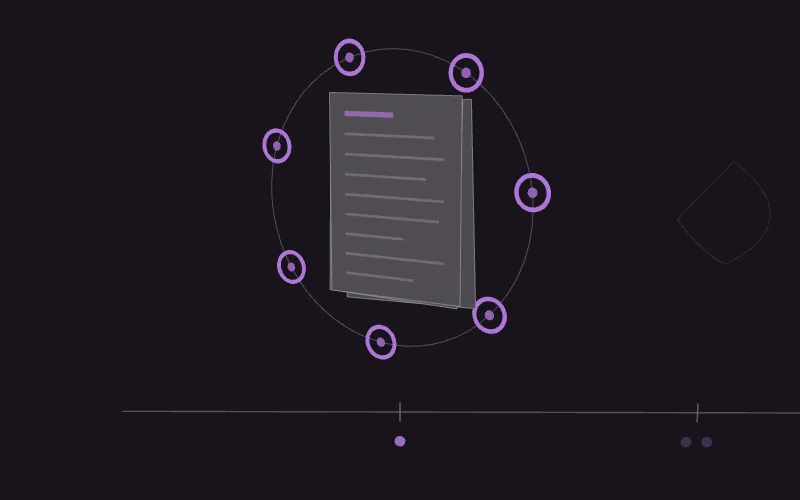
Seven reviewers
Methods
Statistics
Data
Editor
Equations
Literature
Numbers
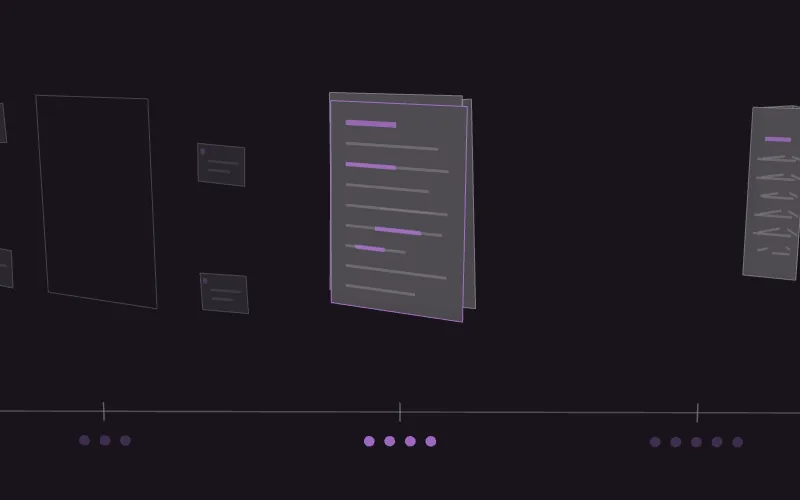
3ReconcileShared findings first, then a coherence check
4DeliverReport, fix-first checklist, annotated PDF
What each check does, and what one chat prompt leaves out
Paper Review
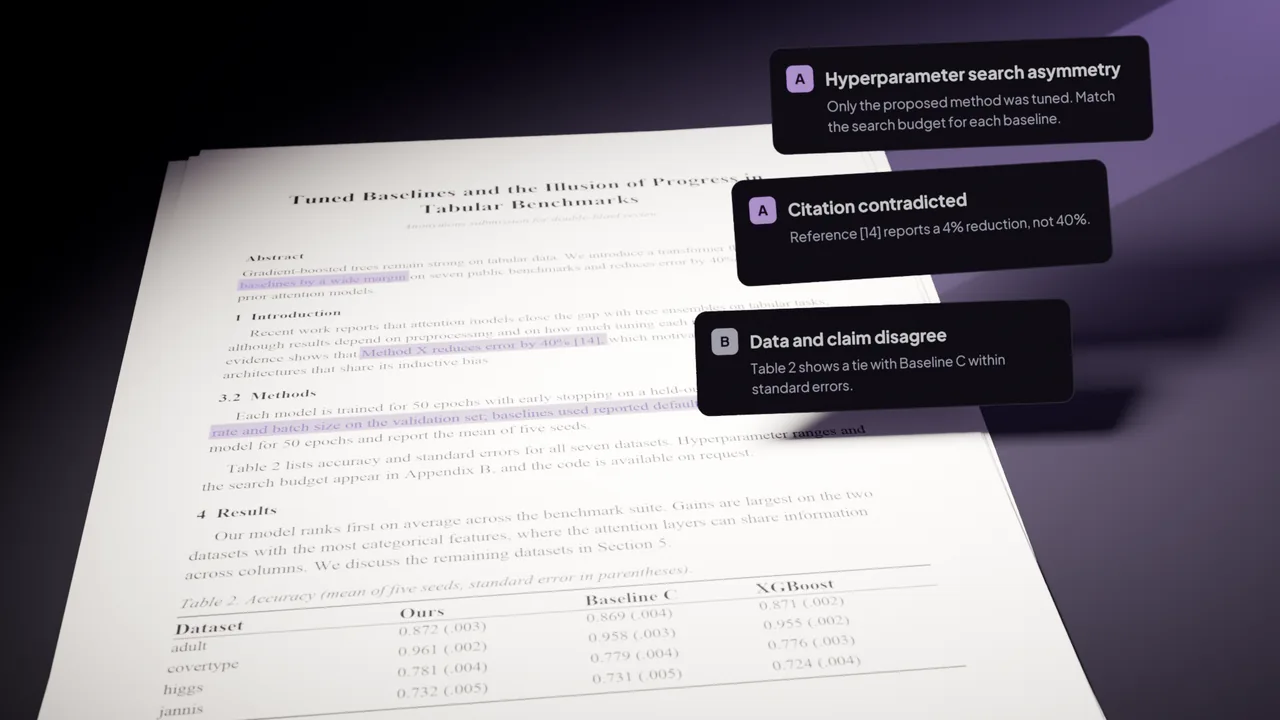
References. Each reference is matched to a CrossRef record, and retractions, withdrawals and expressions of concern are flagged. Up to 40 key claims are checked against the cited source's abstract, fetched from OpenAlex, Semantic Scholar or CrossRef.
Rules, no AI. p-values are recomputed from t, F, chi-square, r and z (statcheck), and reported means are tested for consistency (GRIM). In-text citations are matched to the reference list, and figure and table numbering is checked.
Vision. The first 30 pages are rendered and read as images. Figures are compared with what the text claims, including missing error bars, broken axes and color-only encoding.
Seven reviewers. Methodology, statistics, data integrity, the editor's view, equations, literature and numerical realism each read the paper separately.
Reconcile. Findings are merged, and issues raised by more than one reviewer rank first. A coherence check compares the abstract, hypotheses and results with each other.
Deliver. A report with a fix-first checklist and an annotated PDF arrives by email. The manuscript is deleted within about a day of your first opening the result, or within 48 hours if you never do.
A chat prompt
References are not looked up one by one, so a wrong or invented one can pass.
Retractions are caught only if the model happens to know them.
p-values and means are not recomputed.
One point of view, written in one go.
No marked-up PDF.
Whether the manuscript is kept or used for training depends on your account settings.
The reviewers and the final pass use Claude Opus through Anthropic's API, which does not train on your manuscript.
One manuscript, from the first draft to the response letter.
The three reviews
Each review runs in minutes and arrives on a page that updates itself, with a copy by email.
Before you submit
Paper Review
$14, $24 or $39
Seven AI reviewers read the manuscript the way a panel would (methods, statistics, data integrity, equations, the literature, the numbers and the editor's view). Every reference is checked against CrossRef and the figures are scanned. You get a Markdown report and an annotated PDF.
Standard, $14. One pass by the seven reviewers. 4 to 8 minutes.
Journal, $24. Standard plus a compliance check against the target journal (27 venues). Most authors pick this one.
Deep, $39. Two passes. In the second, each reviewer reads the others' findings and sharpens its own. The journal check is included. 10 to 15 minutes.
Upload the revised manuscript with the Markdown report from your first Paper Review. Revision Review goes through each finding in that report and marks whether the revision addressed it.
Three AI reviewers read the reviewer comments, your response letter and the revised manuscript. They flag replies that are missing or that do not answer the point, and estimate whether the editor will accept or ask for more.
Check a letter, $12. Upload the revised PDF, then paste the comments and your letter.
Draft and check, $24. Upload the revised PDF and paste the comments. You get a reply to every comment, checked against the revised PDF and then reviewed. You edit it before sending.
Start from where the paper is now. To see how Paper Review compares with other AI reviewers, read the test on one eLife manuscript.
You are about to submit
Buy a Paper Review. The $24 Journal tier is the usual choice, because it also checks the manuscript against the journal's own rules. Pick Deep ($39) for a paper you expect a hard panel on.
You have a revise-and-resubmit
If you ran a Paper Review on the first version, a Revision Review ($5) tells you which findings the revision still leaves open. Then check your response letter ($12), or have one drafted and checked ($24).
You want one paper covered start to finish
Buy the Publication Pack ($59). It holds the Deep Review, the Revision Review and the response letter draft, and costs $9 less than buying the three one at a time.
One Deep Review, one Revision Review and one response letter draft. You get three links by email. The links do not expire, and each works once, so you can use the Revision Review and the letter draft months later when the decision arrives.
The pack saves $9 when the paper comes back with a revise-and-resubmit. If you only need the first review, buy the Paper Review on its own.
Bought one at a time
Paper Review: Deep
$39
Revision Review
$5
Response letter draft and check
$24
Separately
$68
In the pack
$59
For labs and research groups
A lab plan gives your group a fixed number of Paper Reviews each month. Each paper reviewed on a plan also gets one Revision Review and one Response Review. A year costs the same as ten months.
Lab
$199 a month
or $1,990 a year
20 Paper Reviews each month. The lab lead gets the individual review links and shares them with members.
Lab Plus
$349 a month
or $3,490 a year
40 Paper Reviews each month, and a group link. Any member opens the group link and starts a review from the shared pool.
A Lab plan used in full comes to about $10 a review, against about $17 in a pack of 20. Plans renew each month or year until you cancel, and you can cancel at any time from the plan page. For a few papers a year, a pack of 5 Journal reviews ($99) or 20 ($349) never expires. To pay by invoice or purchase order, or to compare plans and packs side by side, see the lab page. The plan terms are on the terms page.
What happens to your manuscript
The manuscript is sent to Anthropic's Claude API for the review. Anthropic keeps API inputs for up to 30 days and does not train on them.
The report is emailed to you as a PDF. The manuscript and the online copy of the report are deleted within about a day after you first open the result, or within 48 hours if you never open it.
If a review was not useful, email ben@purplelink.llc within 14 days of purchase and I will refund it.