
Disclosure up front: Purplelink makes Paper Review, one of the tools compared here. I ran it the same way as the others and report where it did worse. Prices come from each vendor's own pages, read on November 13, 2026. Plans change, so check before you pay.
The short answer
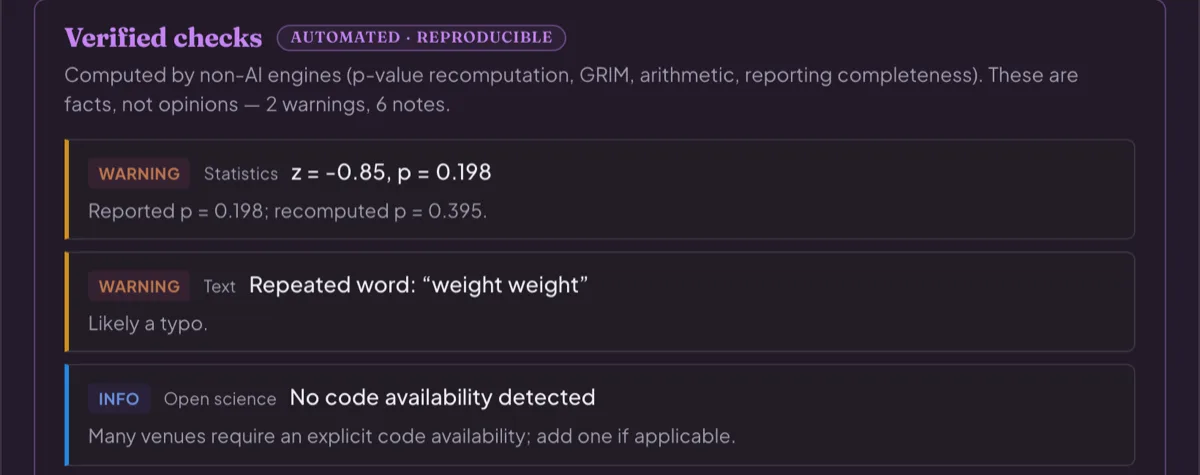
On one psychology and neuroscience manuscript, the Paper Review Deep tier and a single plain prompt to Claude each raised all 12 of the eLife reviewers' points at least in part. Deep raised 5 in full and the Claude chat raised 6. Reviewer3's free review raised 4 in full and 4 in part, and missed the other 4, which are about theory and task design. Each review also found real errors the human reviewers did not mention, and they found different ones. Deep recomputed the statistics and caught a one-tailed test reported as two-tailed. The chat caught a supplementary table whose numbers do not add up. Reviewer3 caught several of the contradictions the other two found, read a mislabelled table column correctly, and raised one confound in the brain-response analysis that no one else did.
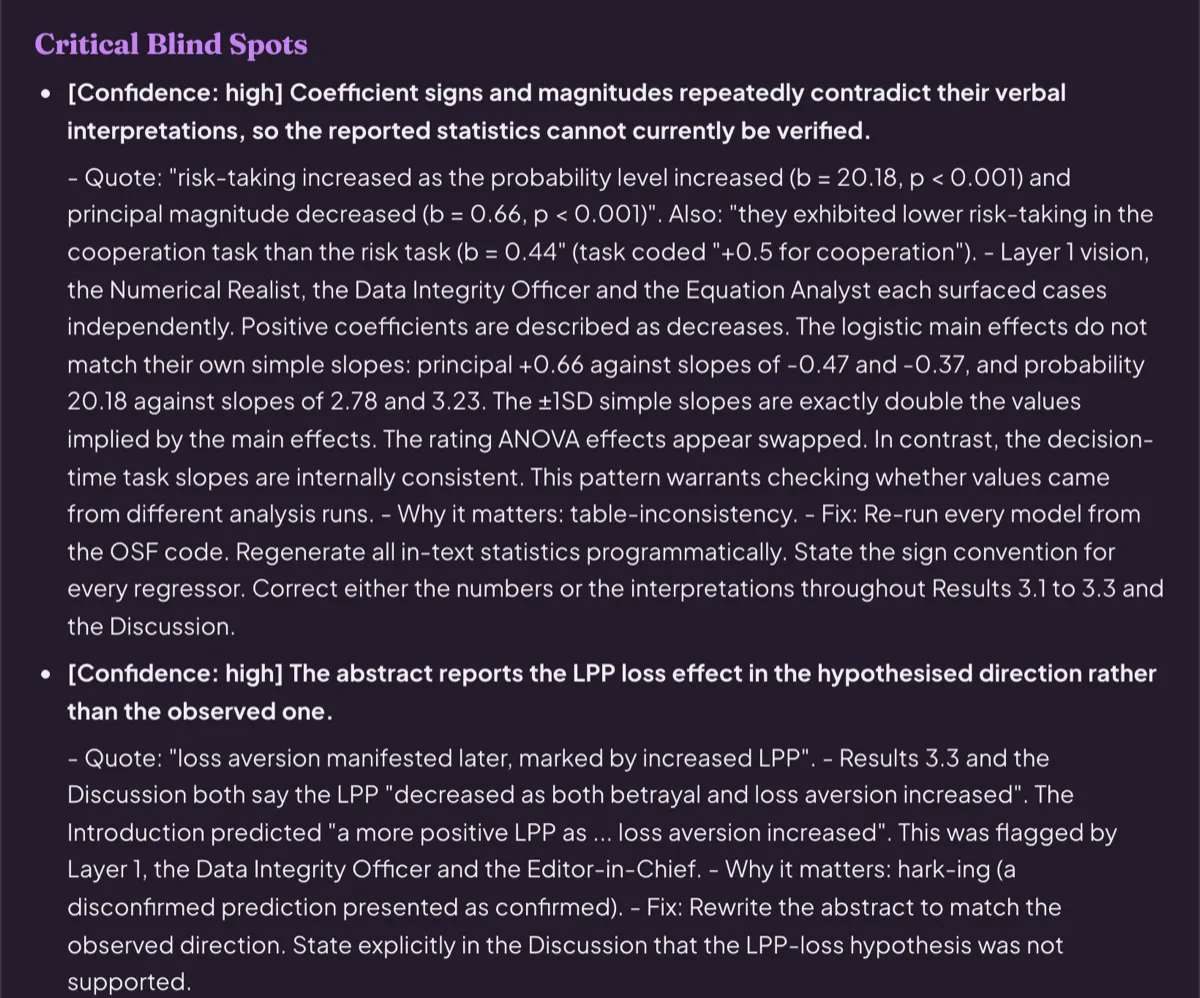
Deep also made a mistake. It marked as a "high confidence" contradiction a set of results that are really a mislabelled table column, and it suggested the numbers might come from different analysis runs. The chat and Reviewer3 both read the same table correctly. So the honest result is this: on this paper, a $39 structured review was not clearly better than a careful chat prompt, and a free Reviewer3 review found about as many numerical errors while covering fewer of the reviewers' broader points. Paper Review's advantages were recomputed statistics, a fixed report format and an annotated PDF, not more correct findings.
One manuscript is a small test. It does not rank these tools in general, and the tools I did not run are marked "compared from public pages, not run" below rather than guessed at.
How I tested
The test paper is "Betrayal is worse than loss during cooperation" by Tang, Tan, Gao, Lin, Gan, Ding and Gao, a bioRxiv preprint released under CC BY 4.0. It has a behavioural task, computational models and EEG, so there is a lot for a reviewer to check. eLife reviewed it and published the reviews as reviewed preprint 111043. I condensed those reviews into 12 distinct points and used them as the answer key.
- Paper Review, Deep tier. Run on November 13, 2026 with a single-use code, so no money changed hands. The list price is $39.
- Plain Claude chat. Claude Sonnet 5.5 with one plain prompt asking for a critical review. It was given the paper's extracted text as a file it could read, with no web search and no way to run code. Pasting the text into a Claude or ChatGPT chat is the closest everyday equivalent.
- Manusights free Readiness Scan. Run the same day. The paid Full Review was not bought.
- Reviewer3, free plan. The same PDF, figures included, uploaded the same day. The review was ready in about 10 minutes. The free plan gives one full review with no card.
- Stanford's PaperReview.ai. Submitted the same day. It sends results by email, and its result is not scored here.
Each review was graded against the 12 points: raised in full, partly raised, or missed. The grading was done by an AI grader that knew which review was ours. Every finding this page calls correct or wrong was checked against the manuscript text. Paper Review and Reviewer3 read the PDF; the chat saw extracted text only. Treat the split between "full" and "partly" as a judgement call. Points 4, 7 and 8 were the close ones, and with looser grading Paper Review and the chat would each score about 9 or 10 of 12. Reviewer3's four misses were clear misses: it made no comment on those topics.
What each review found
Rows are tools. "Not run" means I did not test it, not that it failed.
| Tool (tested 2026-11-13) | Time and cost | eLife points, of 12 | Correct finds the eLife reviewers did not raise | Mistakes |
|---|---|---|---|---|
| Paper Review, Deep | Minutes (10 to 15 stated), $39 | 5 in full, 7 partly, 0 missed | Abstract says the late brain response increased with loss aversion, but the Results report a decrease. A z-test reported as p = 0.198 is one-tailed; two-tailed it is 0.395. An F of 297 for a task effect whose means differ by 0.09 points. Simple slopes exactly double what the model implies. Model 1 called "linear" in the Results and nonlinear in the Methods. A duplicated citation. | Called a mislabelled odds-ratio column a high-confidence contradiction and suggested different analysis runs. Probably misread one figure label. Read only 4 of the references. Its automated check reported no code statement, though the paper links its data and code (the report itself noted this was likely a miss). |
| Plain Claude chat (Sonnet 5.5) | Minutes, inside an existing plan | 6 in full, 6 partly, 0 missed | Supplementary Table S2 does not add up: a parameter count is wrong, a nested model fits worse than the simpler one, and the stated formula does not give the reported number. The odds-ratio column is mislabelled "log odds". Person-level parameters entered into trial-level models. Parameters fitted to the same choices they then "predict". A reference with the authors' first names printed as surnames. | None I could find among the claims I could check. It could not recompute statistics, so it missed the one-tailed test. |
| Reviewer3, free plan | About 10 minutes, $0 (one free review) | 4 in full, 4 partly, 4 missed | The "log odds" column is really odds ratios. The F of 297 belongs to the feedback effect, not the task effect. Table S2 lists the wrong number of parameters, and the winning model beats its task-specific rival by only 0.3 AIC. The brain responses are measured after the stake appears, but the betrayal predictor depends only on the probability shown about 3 seconds earlier. Also found the late-response direction, decision-time direction and Model 1 contradictions that Deep found. | One comment reads the odds ratios as log odds, against its own correct reading elsewhere. One aside about the AIC formula does not check out. 42 comments cover about 26 distinct issues, so many repeat. Missed the one-tailed test and eLife's points on task design and motives. |
| Manusights, free Readiness Scan | About 2 minutes, $0 | Shows 1 of 3 risks; it partly matches points 3 and 9 | None beyond the eLife points in what the free scan shows. | Repeated the one-tailed p = 0.198 without noticing it. |
| Stanford PaperReview.ai | Results by email, free | Not scored | Not scored | Reads only the first 15 pages |
| q.e.d, Explore Science, Trinka, Thesify, Paperpal, SciScore | See prices below | Not run | Not run | Compared from public pages, not run |
Two things stood out. First, the human reviewers were not exhaustive: all three full AI reviews found correct, material errors that none of the eLife reviewers raised. Second, they missed different things. Deep recomputes reported statistics in code, which is how it caught the one-tailed test, but it never checked the numbers in Table S2. The chat read every table closely but could not recompute anything. Reviewer3 was strongest on contradictions inside the paper and weakest on the reviewers' theory and design points. If you use one, another is a reasonable second pass.
What the report looked like
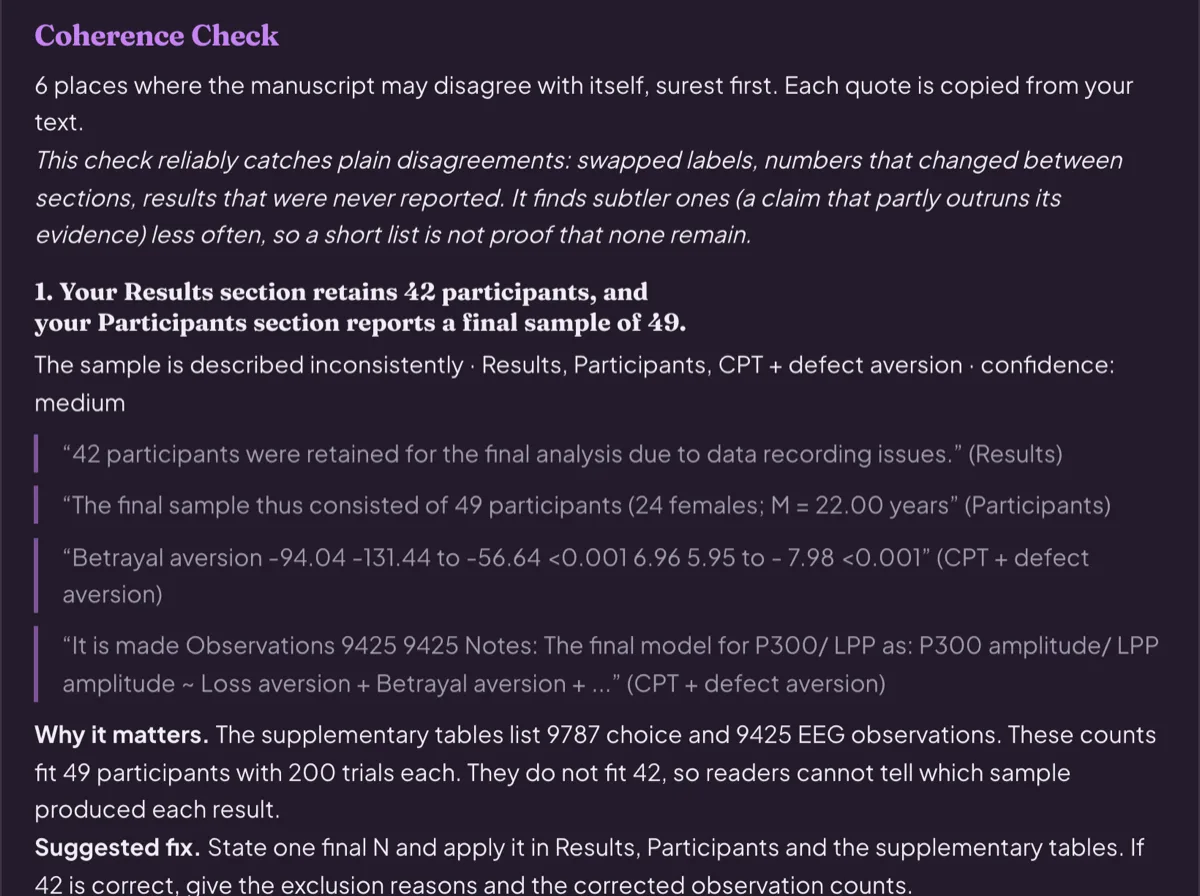
These are crops of the Deep tier's annotated PDF. The captions say which items were right and which were wrong.
Second test: Google Deep Review on an IS paper
Google Research released Deep Review in October 2026. It is free for two reviews a week, so it is now the obvious thing to try before paying for anything, including our tool. It grew out of a tool Google piloted at machine learning and theory conferences, and it shows: its pitch is proofs and technical documents. Most of my own work is in Information Systems, so I wanted to see how it handles a social-science paper.
The test paper is "Why Do Users Switch Mobile Applications?" by Salo and Makkonen, a 23-page qualitative study published in Communications of the Association for Information Systems in 2018. On November 14, 2026 I ran it through Paper Review's Deep tier with no journal check and through Deep Review's free tier. I then gave both reports to one AI judge (Claude Sonnet) with the labels shuffled, so it did not know which report was ours, and checked the claims it relied on against the PDF. Paper Review runs on Claude too, so a Claude judge may share its taste. Treat the scores as one reader's view.
| Scored out of 10 | Paper Review, Deep | Google Deep Review, free tier |
|---|---|---|
| Accuracy | 9 | 9 |
| Critique of the method | 8 | 8.5 |
| Actionability | 9 | 7 |
| Signal versus noise | 8.5 | 5 |
| Overall | 8.5 | 6.5 |
| Length of report | About 5,500 words | About 9,700 words |
| Time to result | 6 minutes | About 30 minutes |
| Price | $39 list | Free (two a week) |
What Paper Review did better. It opened with the paper's central problem: the authors only studied people who had already switched apps, so the data cannot show that trialing is a necessary step before switching, which is what the paper claims. It caught an arithmetic slip in the participants' age breakdown that Deep Review did not mention. It ended with a short fix list in priority order, which is what you need the week before a resubmission.
What Deep Review did better. It was sharper on how the interviews were run: prompts that may have led participants in two of the three phases, collecting answers by email and whether that could reach saturation, and a single coder with no second coder to check agreement. It also confirmed all 52 references. Paper Review's reference check failed on this PDF because it could not split the CAIS reference list into entries. I fixed that the same day, and author-year reference lists in the CAIS, MISQ and APA styles now split correctly.
Where Deep Review fell short. Its report was almost twice as long, and most of the extra length is copy editing: dozens of notes on wording and punctuation sit at the same level as the method problems, so the points that matter are easy to miss. Neither tool invented a citation or misread the paper in a way that mattered.
The difference in price is real, and for a quick read of a theory or machine learning paper the free tool is a fine place to start. Where they differ is what comes after the first read. Deep Review gives you one report. Paper Review is built around getting a paper through a journal: a journal check, a Revision Review that checks which findings you fixed, and a Response Review that checks your letter against the reviewers' comments. One paper and one judge is thin evidence, and I will add papers as I run them.
What each tool costs
From each vendor's own pricing page, read November 13, 2026. "Not shown" means the page I read gave no price.
| Tool | Free route | Cheapest paid option | Other prices |
|---|---|---|---|
| Purplelink Paper Review | Reference check only | $14 Standard review | $24 with a journal check, $39 Deep, $5 Revision Review, $12 Response Review ($24 with a drafted letter). Publication Pack $59 and lab plans at $199 or $349 a month are opening soon. The full workflow · plans |
| Manusights | Readiness Scan, top risks only | $39 Full Review | $99 dossier, $89 for 3 reviews, $139 for 5 |
| Reviewer3 | One full review, no card | $29 a month, Pro | Institutional pricing on request |
| Thesify | None found for the reviewer | €14.95 one review | €39.95 for 3, €24.95 a month, €149.95 a year |
| Explore Science (was Paper-Wizard) | One full review after you verify an account | $50 one paper | $100 a month ($50 for students), $200 a month Pro |
| q.e.d Science | "Free for researchers", limits not stated | Not shown | Enterprise only |
| Trinka | Basic, 5,000 words a month | Not shown for Premium | $300 a year Confidential Data plan |
| Google Deep Review | Two full reviews a week | Your own Gemini API key, billed at Google's API rates | No subscription; read November 14, 2026 |
| Stanford PaperReview.ai | Free | None | First 15 pages, 10 MB, results by email |
| ChatGPT or Claude | Free plans, with upload limits | An existing subscription | No per-paper price |
The tools, one at a time
Purplelink Paper Review
Seven AI reviewers read the manuscript, each from one angle (methods, statistics, data integrity, equations, literature, numbers, editor), and one pass reconciles what they found. Every reference is looked up in CrossRef, reported statistics are recomputed in code, figures are scanned, and the most important citations are checked against the cited abstract. You get a Markdown report and an annotated PDF. The same manuscript can then go through a Revision Review, which checks which findings you fixed, and a Response Review, which checks your response letter against the reviewers' comments. In this test it found more statistical errors than the chat and fewer table errors, and it made one high-confidence misdiagnosis. Your manuscript goes to Anthropic's API, which keeps inputs for up to 30 days and does not train on them; Purplelink deletes its copy within about a day. Refund within 14 days if the review is not useful. Best for a structured pass with recomputed statistics and an annotated PDF, followed by the revision and response steps on the same paper.
Plain ChatGPT or Claude
In this test a single careful prompt to Claude matched Deep on coverage and made fewer mistakes. It read the tables more closely. What it cannot do without tools is recompute statistics or look up references, and you get no fixed format, so a second run can come back different. Check the product's training settings before you paste unpublished work. ChatGPT was not tested here. Best for a free or already-paid first read, if you will check what it says against the paper.
Manusights
The closest direct competitor to Paper Review. The free Readiness Scan took about two minutes and returned a score of 68 out of 100 and one of its three top risks: that the paper's early-then-late brain-response claim rests on a single modest effect. That is a fair point and overlaps two of eLife's. It repeated the one-tailed p-value without noticing. The full review ($39) and a dossier with simulated reviewers ($99) were not bought. Its pages say uploads are not used for training and offer a 60-day money-back guarantee on the Full Review. Best for a free first look at your biggest risk, and journal-fit help if you pay.
Google Deep Review
Launched by Google Research on October 14, 2026. Several agents each take a section of the paper, with more effort on dense parts such as proofs, and a final pass checks the findings against Google Search before you see them. The report gives overall feedback, then major concerns, minor corrections and suggestions, each tied to a passage. It takes 10 to 30 minutes; mine took about 30. You get two free reviews a week, then it runs on your own Gemini API key. Google says uploads are not used for training and are kept for one year. On the CAIS paper above it was accurate and strong on interview procedure, but its main points were buried under copy edits. It has no journal-specific checks, no anonymity check and nothing for the revision or the response letter. Best for a free, thorough first read of a machine learning, theory or technical paper.
Stanford PaperReview.ai (compared from public pages, not scored)
A free reviewer from a Stanford research group. It takes a PDF up to 10 MB, reads only the first 15 pages, and emails the review. It is tuned toward fields that post on arXiv, and the pages I read did not state a data policy. Best for a free second opinion on a short, computational paper.
Reviewer3
Splits a paper into claims and checks the evidence for each, verifies references, looks for fatal flaws and can rerun submitted code. The free plan gives one full review with no card; Pro is $29 a month. In this test the free review took about 10 minutes and left 42 comments pinned to quotes in the manuscript. It was the best of the three at contradictions inside the paper: the odds-ratio label, the swapped ANOVA effect, the Table S2 counts and the near-tie between models. It said nothing about whether the task really measures betrayal, and many comments repeat each other. Its security page says uploads are never used for training. Best for papers that ship code you want rerun against the text, and anyone with several papers a month.
q.e.d Science (compared from public pages, not run)
Breaks a paper or grant into claims, marks gaps with suggested fixes and places the findings against related work. It is free for researchers with an institutional email. Its data statements conflict: the site says uploads are not used to train language models, while its terms allow it to train and evaluate its own models. Best for a free claims-and-gaps read, if those terms are acceptable for your manuscript.
Explore Science, formerly Paper-Wizard (compared from public pages, not run)
A scorecard review with reference checks and a chat assistant, plus journal and funding matching. One full review is free after you verify an account; after that it is $50 a paper or a monthly plan. The site says the review takes hours. Best for one free full review when you are not in a hurry.
Thesify (compared from public pages, not run)
Critiques argument, methods, evidence and structure, graded by severity, with journal suggestions. No free review was offered on the pricing page; one review is €14.95. It says documents are not used to train public models. Best for students and early-career authors who want feedback on the argument at a low one-off price.
Trinka (compared from public pages, not run)
Mainly an academic grammar and language tool, with plagiarism, citation and "technical" checks bought as credits. The free Basic plan covers 5,000 words a month. Only the $300-a-year Confidential Data plan states no AI training. Best for language polishing, not methods critique.
Paperpal Preflight and Penelope.ai (compared from public pages, not run)
Both check a manuscript against a journal's submission rules: word limits, required sections, declarations, reference style. Neither judges the science. Paperpal's pages did not show a price in the version I could read. Penelope.ai is sold to journals, from £750 a year, so most authors meet it at submission. Best for avoiding a formatting desk rejection.
SciScore (compared from public pages, not run)
Checks a life-science methods section against rigor and reporting standards (blinding, randomisation, sample size, resource identifiers). Authors now start through Aseda Sciences with an ORCID sign-in; I did not find a current price. Best for wet-lab and animal studies, and little else.
No longer available or out of scope
StatReviewer, an automated statistics checker that ran inside journals' editorial systems, has no working site; the most recent material I found dates from 2016 to 2018. Enago's peer-review service page returned an error on November 13, 2026, so I have left its earlier price out. Writefull is a language tool and does not review a paper.
Decision matrix
| If you want | Start with | Why |
|---|---|---|
| A free first read | Reviewer3's free review, a careful Claude or ChatGPT prompt, or the Manusights free scan | In this test Reviewer3 caught many numerical contradictions and the chat matched a paid review on coverage |
| A free read of a machine learning or theory paper | Google Deep Review | Two free reviews a week, built for proofs and technical papers |
| An IS or social-science paper headed to a journal | Paper Review Deep or Journal tier | In the CAIS test it led with the main flaw and gave a ranked fix list; the revision and response steps follow |
| Recomputed statistics and an annotated PDF | Paper Review, $14 to $39 | It caught the one-tailed test the others missed |
| One paper from review to response letter | Paper Review workflow | Review, revision check and response check on the same manuscript |
| Code in the paper rerun | Reviewer3 | States it can run submitted code (not tested here) |
| Many papers a month | Reviewer3 Pro, or Paper Review lab packs | Flat monthly price or per-review discount |
| Journal formatting rules | Paperpal Preflight, or the Paper Review Journal check | Built for submission requirements |
| A life-science methods section | SciScore | Built for rigor reporting standards |
Whichever you pick, read every finding against your own paper. In this test Paper Review made a confident mistake, the Manusights scan repeated an error from the paper, and the chat missed things the others caught. For how to fit AI tools around human readers, see how to get feedback on a paper before submitting.
Test paper: Tang, Tan, Gao, Lin, Gan, Ding and Gao, "Betrayal is worse than loss during cooperation", bioRxiv, 2026, doi:10.64898/2026.03.04.709582, CC BY 4.0. Reviewer points summarised from the public eLife reviews of reviewed preprint 111043. Second test paper: Salo, M., and Makkonen, M., "Why Do Users Switch Mobile Applications? Trialing Behavior as a Predecessor of Switching Behavior", Communications of the Association for Information Systems, 42, 2018, doi:10.17705/1CAIS.04214.